Why OCR Matters: Unlocking the Hidden Knowledge in Your Documents with AI
By Luke Sheneman and John Brunsfeld, AI4RA
Artificial intelligence is changing how universities search, summarize, analyze, and generate information. AI is powerful, which is perhaps why less experienced users are sometimes surprised by this limitation:
If AI cannot understand a document, it cannot read.
Many of the documents that we feed AI –– PDFs, scanned reports, grant proposals, contracts, handwritten notes, and historical records –– are nothing more than pictures of text or a hybrid of text and images mashed together. To humans, they look perfectly readable. To a large language model (LLM), however, they’re often just collections of indecipherable pixels.
This is where Optical Character Recognition (OCR) becomes essential.
What is OCR?
OCR is the process of converting images of text into actual machine-readable text.
For example, OCR transforms this:
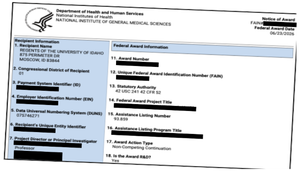
into this:
Department of Health and Human Services
National Institutes of Health
NATIONAL INSTITUTE OF GENERAL MEDICAL SCIENCES
Notice of Award
FAIN#: ***********
Federal Award Date: 06/23/2026
Recipient Information
1. Recipient Name
REGENTS OF THE UNIVERSITY OF IDAHO
875 PERIMETER DR
…
Once converted, the document becomes searchable, indexable, and understandable by AI systems.
Without OCR, even the world’s most advanced language models are unable to fully analyze large collections of scanned documents.
AI is Only as Good as the Text It Receives
Large language models (LLMs) are remarkably capable, but they can generally only analyze content that is available as text. When a proposal includes embedded scanned pages, faxed signatures, photographs of printed reports, or older scanned grant documents, those portions may be effectively invisible to an AI system unless they have first been processed with optical character recognition (OCR). By converting the words within images into machine-readable text, OCR enables LLMs to fully understand, search, summarize, and reason over the complete contents of a proposal rather than only the text that was originally digital.
High-quality OCR dramatically improves:
- search accuracy
- retrieval quality
- AI summaries
- question answering
- citation accuracy
Simply put: Better OCR leads to better AI.
Why This Matters for Research Administration
Research administrators manage enormous collections of documents:
- Grant proposals
- Award notices
- Contracts and subawards
- IRB documentation
- Budget justifications
- Progress reports
- Compliance records
- Historical proposal archives
- Meeting minutes
- PDFs from sponsoring agencies
Many of these documents arrive as scans or image-based PDFs.
Without OCR, important information often remains inaccessible to people and incompatible with AI functions. Large language models cannot reliably answer questions about text embedded in scanned documents or images; keyword searches miss critical content; and years of valuable institutional knowledge remain locked away in files that cannot be easily searched or analyzed.
With OCR, every document becomes fully searchable and accessible. AI can summarize lengthy reports, staff can ask natural-language questions about document collections, and historical records become instantly available for search, analysis, and knowledge discovery.
Instead of hunting through dozens of PDFs, users can simply ask:
“Which proposals referenced precision agriculture between 2019 and 2024?”
or
“Find every award that included cost sharing.”
OCR at University Scale
Over the past year, the AI4RA team has built a high-throughput OCR platform capable of processing institutional document collections at remarkable speed, hosted via MindRouter.
The system has already processed approximately:
- 20 million pages
- More than 5 billion words
- Hundreds of documents every minute using our GPU infrastructure
This transforms decades of institutional documents into AI-ready knowledge.
OCR Powers Better AI in Vandalizer
OCR is one of the key technologies behind Vandalizer, the University of Idaho’s AI-enabled document analysis tool.
When documents have been OCR processed:
- AI can search them quickly.
- Responses become more complete.
- Important information is less likely to be missed.
- Users receive better summaries with more accurate references.
Rather than opening dozens of files, users can simply ask questions in plain English and let AI locate the relevant information.
Beyond Search
OCR enables much more than document search. Once text has been extracted, AI can:
- summarize long reports
- compare multiple proposals
- identify trends across years
- extract deadlines
- locate compliance language
- identify funding opportunities
- organize historical archives
- support institutional knowledge management
In many ways, OCR serves as the foundation that makes these advanced AI capabilities possible.
A Small Step with a Big Impact
OCR isn’t flashy. Most users never notice it in action.
Yet it is one of the most important technologies enabling modern AI workflows.
Every scanned document that is converted into searchable text becomes another piece of institutional knowledge that AI can readily understand, analyze, and help put to work.
For research administrators, that means less time searching for information and more time supporting researchers, advancing proposals, and managing awards.
As AI tools like Vandalizer continue to evolve, OCR will remain one of the foundational technologies that helps transform decades of institutional documents into accessible, searchable, and actionable knowledge.