

LLM-as-a-Judge: The Importance of Harshness
By Michael Overton
Editor’s Note
At its heart, this piece tackles a problem that’s becoming more relevant as AI tools spread into everyday work: how do you check the quality of something an AI produced, when there’s no answer key to grade against? Dr. Michael Overton’s answer (using one AI model to evaluate another’s output) is a clever workaround, but the real discovery here is more subtle and more useful. It turns out that how you ask the AI judge to evaluate matters enormously. When prompted to simply assess quality, the AI grader tended to hand out generous, feel-good scores across the board, the way a polite colleague might soften their feedback in a performance review. But when nudged to act as a strict, critical evaluator, the same AI began drawing sharper distinctions between good and mediocre work, surfacing flaws it had previously glossed over. The takeaway isn’t just academic: anyone using AI to review writing, summarize documents, or check other AI-generated content should know that the instructions you give the evaluator can quietly shape the verdict. A small tweak in tone, “be a tough critic” versus “give your assessment,” can be the difference between useful feedback and empty praise.
Evaluating LLMs with…LLMs:
I have a growing fascination with evaluating the outputs of Large Language Models (LLMs). The core question is simple, yet daunting: How do we evaluate complex natural language outputs at scale? The most trusted evaluator is a human expert, but experts are difficult to find, expensive, and human-in-the-loop evaluation practices don’t scale. There is an added challenge when the “correctness” of a requested LLM response is subjective. If there is ground truth, then we can evaluate the accuracy of an LLM (i.e., how often it is correct). However, when there is no true “correct” response, even human evaluators can inject substantial bias into their assessments.
One promising solution is an approach called LLM-as-a-Judge (Zheng, 2023) where we use LLMs to judge LLMs. It is an elegant idea and scalable solution to the evaluation problem as LLM judges can be prompted for a variety of different evaluation tasks. Further, this approach solves evaluation concerns when the “correctness” of LLM outputs is either unknown (in the case of data without labels) or unknowable (in the case of outputs like summaries). While this method introduces a number of known biases, those are beyond the scope of this blog post.
Background
I am very interested in using multiple LLM judges to provide wholistic evaluations of LLM outputs so, I decided to run a small test evaluating LLM sentiment analysis results from a side-project. Sentiment analysis is somewhat subjective (coders look at a text and decide if it expresses a positive, neutral, or negative sentiment). I took a random sample of 400 observations and selected the outputs of 4 models to compare the results. I used GPT-OSS with 120 billion parameters as the judge model.
Models being Evaluated
- Command A (best performing model on the sentiment task)
- GPT-oss (High performing thinking model)
- Phi 4 (small, yet relatively high performing model)
- Gemma 3 (underperforming model for comparative purposes)
Judge Prompt and Criteria
I used the G-eval prompt (Liu, 2023) as the foundation for the judge prompt and I made individual prompts for each of the following 9 criteria:
- Fluency
- Coherence
- Plausibility
- Entailment
- Factuality
- Faithfulness
- Relevance
- Informativeness
- Restatement
The results from these prompts were less than encouraging. They suggested lots of very ‘nice’ judgements, which you can view in the next section. Great when practicing emotional intelligence, and awful when trying to identify nuanced flaws/differences.
Harsh Evaluator
As an experiment, I added a few lines to the judge’s prompts doing something I generally stay away from–role prompting. Basically, I added three lines prompting the LLM to be a “harsh but fair evaluator”. Relatively minor, but it made all the difference. The full prompt can be found in the appendix.
| Model | Linguistic | Logic | Information Fidelity | Informativeness | |||||
|---|---|---|---|---|---|---|---|---|---|
| Fluency | Coherence | Entailment | Plausibility | Factuality | Faithfulness | Relevance | Information | Restatement | |
| Not Harsh | |||||||||
| Command-a-16k:111b | Linguistic · Fluency4.61 | Linguistic · Coherence4.89 | Logic · Entailment4.97 | Logic · Plausibility4.03 | Info Fidelity · Factuality4.74 | Info Fidelity · Faithfulness4.46 | Info Fidelity · Relevance5.00 | Informativeness · Information3.83 | Informativeness · Restatement4.28 |
| Gemma3-64k:27b | Linguistic · Fluency4.52 | Linguistic · Coherence4.84 | Logic · Entailment4.89 | Logic · Plausibility4.03 | Info Fidelity · Factuality4.72 | Info Fidelity · Faithfulness4.38 | Info Fidelity · Relevance5.00 | Informativeness · Information3.82 | Informativeness · Restatement4.46 |
| Gpt-oss-32k:120b | Linguistic · Fluency4.65 | Linguistic · Coherence4.86 | Logic · Entailment4.94 | Logic · Plausibility4.07 | Info Fidelity · Factuality4.81 | Info Fidelity · Faithfulness4.51 | Info Fidelity · Relevance5.00 | Informativeness · Information3.72 | Informativeness · Restatement4.36 |
| Phi4:14b | Linguistic · Fluency4.55 | Linguistic · Coherence4.87 | Logic · Entailment4.96 | Logic · Plausibility4.14 | Info Fidelity · Factuality4.73 | Info Fidelity · Faithfulness4.43 | Info Fidelity · Relevance5.00 | Informativeness · Information3.95 | Informativeness · Restatement4.33 |
| Harsh | |||||||||
| Command-a-16k:111b | Linguistic · Fluency4.36 | Linguistic · Coherence4.50 | Logic · Entailment4.92 | Logic · Plausibility3.75 | Info Fidelity · Factuality4.60 | Info Fidelity · Faithfulness4.37 | Info Fidelity · Relevance5.00 | Informativeness · Information3.74 | Informativeness · Restatement4.23 |
| Gemma3-64k:27b | Linguistic · Fluency4.29 | Linguistic · Coherence4.31 | Logic · Entailment4.80 | Logic · Plausibility3.78 | Info Fidelity · Factuality4.55 | Info Fidelity · Faithfulness4.27 | Info Fidelity · Relevance5.00 | Informativeness · Information3.73 | Informativeness · Restatement4.36 |
| Gpt-oss-32k:120b | Linguistic · Fluency4.47 | Linguistic · Coherence3.63 | Logic · Entailment4.85 | Logic · Plausibility3.83 | Info Fidelity · Factuality4.69 | Info Fidelity · Faithfulness4.41 | Info Fidelity · Relevance5.00 | Informativeness · Information3.56 | Informativeness · Restatement4.23 |
| Phi4:14b | Linguistic · Fluency4.33 | Linguistic · Coherence4.41 | Logic · Entailment4.92 | Logic · Plausibility3.87 | Info Fidelity · Factuality4.54 | Info Fidelity · Faithfulness4.34 | Info Fidelity · Relevance4.99 | Informativeness · Information3.88 | Informativeness · Restatement4.26 |
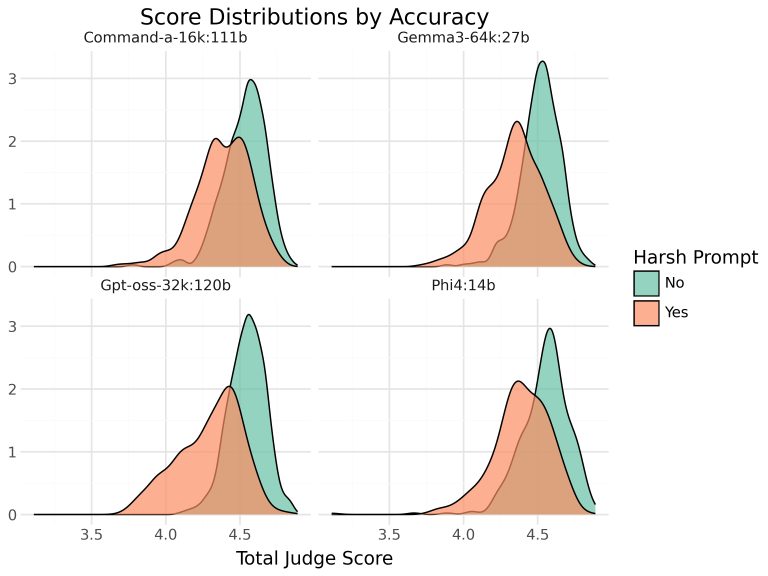
You can see the distributions of the scores between the harsh and not harsh prompts differ in meaningful and statistically significant ways. Harsh prompts have wider distributions of scores meaning that we got an increased breadth of responses from the judge model.
| Test | Interpretation |
|---|---|
| t-test (Welch) | InterpretationDifference in means |
| Mann–Whitney U | InterpretationDifference in medians/ranks |
| Kolmogorov–Smirnov | InterpretationDifference in distributions (CDF) |
| Wasserstein distance | InterpretationDifference in distributions (distance metric) |
| Model | Kolmogorov–Smirnov | Mann–Whitney U | Wasserstein distance | t-test (Welch) |
|---|---|---|---|---|
| Command-a-16k:111b | Kolmogorov–Smirnov0.343 | Mann–Whitney U41,756 | Wasserstein distance0.147 | t-test (Welch)−12.633 |
| Gemma3-64k:27b | Kolmogorov–Smirnov0.470 | Mann–Whitney U35,362 | Wasserstein distance0.173 | t-test (Welch)−15.178 |
| Gpt-oss-32k:120b | Kolmogorov–Smirnov0.525 | Mann–Whitney U24,569 | Wasserstein distance0.248 | t-test (Welch)−20.128 |
| Phi4:14b | Kolmogorov–Smirnov0.375 | Mann–Whitney U40,518 | Wasserstein distance0.161 | t-test (Welch)−12.779 |
Bold = p-value < .1 and statistically significant.
GPT-OSS: The Outlier
I purposefully included GPT-OSS as both the judge model and the model to be judged since judge models tend to show favorable bias toward their responses. There are two odd results I wanted to highlight and one result before I forget it. GPT-OSS was much harsher on itself than other models. Below I show the average responses and I chart the average difference between the Not Harsh response and the Harsh response. GPT- OSS judges itself very differently than other models, and surprisingly it seems to overreact when responding to the harsh prompt.
Does this hold with a larger sample? Will it hold across models or is this true for only GPT- OSS? I’m not sure, but it is something to keep an eye on.
| Model | Prompt | Linguistic | Logic | Information Fidelity | Informativeness | |||||
|---|---|---|---|---|---|---|---|---|---|---|
| Fluency | Coherence | Entailment | Plausibility | Factuality | Faithfulness | Relevance | Information | Restatement | ||
| Gpt-oss-32k:120b | PromptNot Harsh | Linguistic · Fluency4.65 | Linguistic · Coherence4.86 | Logic · Entailment4.94 | Logic · Plausibility4.07 | Info Fidelity · Factuality4.81 | Info Fidelity · Faithfulness4.51 | Info Fidelity · Relevance5.00 | Informativeness · Information3.72 | Informativeness · Restatement4.36 |
| Gpt-oss-32k:120b | PromptHarsh | Linguistic · Fluency4.47 | Linguistic · Coherence3.63 | Logic · Entailment4.85 | Logic · Plausibility3.83 | Info Fidelity · Factuality4.69 | Info Fidelity · Faithfulness4.41 | Info Fidelity · Relevance5.00 | Informativeness · Information3.56 | Informativeness · Restatement4.23 |
Works Cited
Liu, Y. D.-e.-4. (2023). "G-eval: NLG evaluation using gpt-4 with better human alignment.". arXiv preprint arXiv:2303.16634 .
Zheng, L. W.-L. (2023). "Judging llm-as-a-judge with mt-bench and chatbot arena.". Advances in neural information processing systems(36), 46595-46623.
Appendix: Harsh Prompt
The three changes I made to the Harsh prompt are as follows: Change 1) First Sentence in Task Overview I added “Act as an extremely harsh, but fair evaluator.” Change 2) The third bullet point, in Instructions I added “Before proceeding, remember that you are to respond as a harsh critic.” Change 3) I added a bullet point between eight and nine, the new bullet point nine in Instructions I added “9. Review your responses to ensure you are a harsh but fair evaluator. Be critical and honest with your evaluation. Change your response if necessary.”